Friday, January 14, 2011

Whose money is it anyway?

There is a category of companies in the market in which a very peculiar situation is being played out. Just take a look at this;


Now, what is common in these totally diverse companies? All of their names end in "Ltd"? Umm, yup, but there is another thing common; all these companies have sold their businesses (assets only) and received cash (bigtime!) for the sale. It is a very convenient way for transferring ownership to others (read firangs) bypassing the pain of open offers/delisting etc etc.

The critical question is, why is the market not valuing these companies at least at the net cash on books? Why are these companies getting pathetically valued? And have the actions by these companies generated wealth/benefited the minority shareholders in any way?

Well, the answer is NO! Shareholders have rarely earned in all these situations. The primary reasons for this are:

  1. Very little transparency: Rarely do the promoters/management of these companies share what exactly they intend to do with the money that the company receives. Which business will they put it into? Do they have expertise in any new business/venture? No-one really knows.
  2. Getting into unrelated business: e.g. Laffans, which was a chemical company announced that they will not payout any money to the shareholders, and instead will utilise that money to get into logistics business!
  3. Not sharing much money with the shareholders: In some of these cases, the companies do not payout anything as dividend to the shareholders. In some cases, the companies initiate a buyback. But in most, they retain most of the money in the company. Again, what will they do with it??
  4. The 'gall bladder effect': When the gall bladder is full of liquids, one pisses it off. Similarly, when there is too much cash in the company, there is a high probability that promoters may piss it off!! :-) The money may be pilfered or spent on absolutely worthless stuff without any benefit to the minority shareholders.
To cite an example, let us take a look at Gwalior Chemicals (Geecee Ventures)...

The facts:
  • In June 09, Gwalior was trading at about Rs.100, with a market cap of about Rs.250 cr. Debt on books was Rs.150 cr. (Today, its CMP is Rs.51, with a market cap of Rs.105 cr.)
  • At that time, the company announced the sale of their entire operating business to Lanxess for Rs.536 cr. From the proceeds, they retired debt of Rs.156 cr and were left with about Rs.380 cr.
What they had said:
  • The management had announced that the company will return Rs.100 cr out of this money to the shareholders through dividend and/or buyback.
  • The management had also announced in the media that the company will invest the remaining money in specialty chemicals and power generation businesses.
And what they actually did:
  • The company did not pay any dividend. They, however utilised Rs.50 cr for buyback, in which the promoters also participated.
  • There is no word about any specialty chemicals/power business. IN FACT, the company recently amended its 'objects clause' in the Memorandum of Association and has now become an NBFC!!!!! So all this money will now not go into an operating business, but will be invested!! Where?? Who has the qualification and experience to handle such a large amount of money? No-one really knows. :-( Maybe the promoters have realised that being an 'investor' in others' business can be more profitable than doing business themselves. Hell, if all promoters start thinking and doing that, what will you and me do???!!! :-D

So whose money is it anyway?? The company's? The shareholders'? Or just the promoters'? Hmm...

What one should learn from the same is that, given this experience, the market will be very wary of such situations and will not accord them proper valuations. Therefore, before jumping into any such opportunity, one should surely think twice (minimum). These can very well end up being 'value traps'. (Recently, Riddhi Siddhi Gluco Biols has announced something similar. Let us see how that goes!)

Cheers and happy investing!

P.S. I am not at all saying that all companies have been unfair to shareholders. e.g. Piramal Healthcare has taken some good steps and have been transparent to some extent. All I am saying is one should be careful in such situations and not rush to invest, sensing value in the situation. 

Wednesday, January 12, 2011

Jyoti Structures Ltd - Interesting rights issue

Jyoti Structures Ltd (JSL) is basically a power EPC company, executing projects in power transmission, substation and distribution. The company has operations in India, Middle-East and Africa.

The company had recently announced a rights issue, the terms of which are as follows:
  • The company will issue 1 non-convertible debenture of Rs.120 for every 8 shares held.
  • Along with the NCD, 2 warrants, convertible into equity shares will also be issued ‘free’. Effectively, for every 8 shares held, one gets 1 NCD and 2 warrants.
  • The NCD will be redeemed after a period of 15 months at par. Till then the company will pay interest on the same @ 7% p.a.
  • The warrants will be converted into equity shares at Rs.120 within 18 months of the issue.
  • The record date for the same is 15th January 2011. The stock goes ex on the 13th.
  • Both the NCDs as well as the warrants will be separately listed.

The opportunity (?)

  • Buy shares of JSL before ex-date (a larger position can be taken in view of the ratio). Sell them on/after the ex-date.
  • After that, apply for the NCDs and warrants. (Apply for more than what you are entitled to. You might get lucky!) ;-)
  • So what one will be left with are the NCDs and warrants.
  • Hold on the NCDs or sell them off post listing. What remains with you are warrants which will be converted into equity at a later date. 
  • However, till then, your capital does not remain invested. In future, at the time of conversion, if the price is above Rs.120, one makes profit. If not, just let the warrants lapse and you don’t lose anything. Heads you win, tails you don’t lose!
Is it that simple? ABSOLUTELY NOT!

Lets consider a few more points:

Wont the stock price fall on the ex-date? Wont there be a loss while selling the existing shares?
The warrants conversion price is almost the same as the CMP. Just like it happens post a QIP issue, I don’t expect the price to fall on the ex-date because of this event.

The NCDs are yielding only 7%. Could they list at a discount then? Alternatively, if one holds on to the same, what about the opportunity loss, since one is getting lower returns here than a regular bank FD.
This is a very valid point. There is an opportunity loss of about 2%, in case one holds on to the NCDs and I think they would surely list at a discount to the par value. One should keep that in mind.

Will the stock price rise in the near future? Will the price be more than the conversion price, at the time of conversion?
That is anybody’s guess!!! However, consider the following points:
  • At current market cap, the stock does not appear to be over-the-top expensive.
  • The company has an order book position of more than 2x FY10 sales.
  • The management is very clear that they do not take up orders which hit their margins. They do not want to grow just for the sake of topline.
  • Powergrid is expected to release orders in the near future. JSL could be a huge beneficiary.
  • Promoters have been buying material quantities in the recent past.

Although all this does not guarantee that the stock will move up, one should consider the same. And in case it does not move up by the time of conversion, one can just let the warrants lapse.
Effectively, one can create a convertible-equity-instrument, without having any capital blocked and paying little cost. The cost would be 2% on Rs.120 (NCD interest opportunity loss) = Rs.2.4, for 2 warrants. Which is Rs.1.2 per warrant. Interesting!

Views, opinions, brick-bats and ridicules are most welcome!

Cheers and happy investing!

Friday, December 31, 2010

Alembic Ltd - Demerger

New year 'celebrations' are nothing but another excuse to drink. So wish you all a very very happy new year. :-)
Now that we have the 'happy new year' and all out of the way, lemme come to the point. Alembic Ltd is executing a demerger scheme. Let us see if there is any money to be made here.


Alembic Ltd is basically a pharma company, into API and formulations. The company can be divided into two parts; one which contains the entire pharma business, except the PenG business. This is a profitable business with 12-13% operating margins and 6-7% PBT margins. The other part contains PenG business, land and power assets. The PenG business is a loss making business, as detailed later.


The scheme:

  • Under the scheme of demerger, the first part of the business (the good part) will be transferred to Alembic Pharma Ltd. (Alembic Pharma (APL) is currently a wholly owned subsidiary of Alembic Ltd.) 
  • Alembic will retain the second part (PenG business, land, power assets).
  • The total debt of Alembic will be split into 85%(APL) and 15%(Alembic)
  • Shareholders of Alembic holding 1 share will get 1 share in Alembic Pharma.

The shareholding:


Public holding in APL would be lesser, since Alembic already holds some shares in APL.


The facts:
  • Currently, the market is valuing Alembic at Rs.900 cr mkt cap and EV of about Rs.1280 cr. On a PE basis, the stock is currently quoting at about 20x.
  • The pre-demerger numbers of Alembic also include those of PenG division. This is a loss making division of the company, with Rs.115 cr revenues and Rs.24 cr loss before tax for FY10.
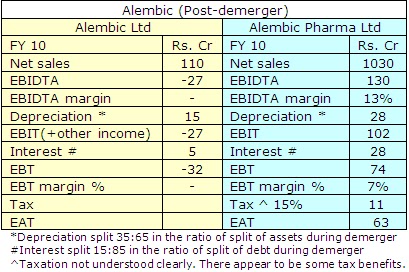
  • If the FY10 numbers are split to reflect the demerger effect, it would be as follows: 


The opportunity:

Let us try and value the two businesses separately:

Alembic Pharma Ltd:
  • This company would contain the API and formulations business (domestic as well as export). FY10 revenue attributable for this company was Rs.1030 cr, with operating profit margins of around 12.7% and PBT margin of 6.8%. EBITDA of Rs.130 cr and EBT of Rs.74 cr.
  • The business is profitable and growing at 10-12%. APL also has recognized brands such as Althrocin, Roxid and Azithral in its portfolio.
  • Post demerger, APL would have no further need of expansion. Consequently, the free cash generated by the business would be utilized for repayment of debt. (APL debt Rs.350 cr. Alembic total cash from operations for FY10 Rs.127 cr). Consequently, in the EV, the debt should be replaced by market-cap going forward next couple of years.
  • Alembic’s peers and companies in the sector quote at premium valuations, as much as 12x EV/EBITDA and 24x TTM EPS.
  • Valuing Alembic at lower multiples of 10x EV/EBITDA(FY10) and 15x FY10 PAT, market cap comes to around Rs.950 cr. Value per share = 950/18.84 = Rs.50/- (to be used as a reference only).

Alembic Ltd:
  • Post demerger, Alembic will be left with the loss making PenG business, land and power assets. Also, it will have 29.5% stake in APL. Residual assets of Alembic would be Rs.250 crores, which is 35% of gross block.
  • On a conservative basis, I would value the PenG business at ZERO (although it certainly should be accorded some value).
  • Alembic will hold 29.5% of APL, which is worth Rs.280 cr. I am giving a 90% haircut to this and taking only 10% of the value, Rs.30 cr. (Pessimistic calculations help provide some MOS)
  • The power assets consist of 3 cogen plants, total 11 MW and 4 windmills of total 5 MW. Since they are used for captive consumption, I would accord them ZERO value.
  • Alembic would also have land of 115 acres at Vadodara. Out of this, the manufacturing facilities occupy about 45 acres. So what should be valued is only 70 acres. As per information obtained, the land rate in the area is Rs.600-700 per sq.ft. I would value the land at Rs.500/sq.ft. Valuation works out to Rs.140 cr.So, the residual business of Alembic may be valued at Rs.30 cr + Rs.140 cr = Rs.170 cr, or Rs.13 per share.

Total valuation comes to Rs.63 per share. (Rs.50 for APL and Rs.13 for Alembic)

To sum up:
  • Dilution in APL is killing off possible arbitrage in the deal.
  • To get some margin of safety, stock can be bought below Rs.55 per share.
  • There is a probability that BOTH the companies may get delisted for some period of time. (Got to get clarification from the CS on this).
  • regarding the time involved in this deal happening, the management had this to say in a recent TV interview: "The demerger is in process right now. We are awaiting some final approvals which we should hopefully get by the end of December and if all the timelines go well then hopefully by about March we will look at listing a separate company."

At CMP of 67 bucks, I do not think there is much money to be made. Lets hope that the stock drifts down. Position should be taken only if the stock comes at a price where there is comfort.

Cheers and happy investing!