Friday, December 31, 2010

Alembic Ltd - Demerger

New year 'celebrations' are nothing but another excuse to drink. So wish you all a very very happy new year. :-)
Now that we have the 'happy new year' and all out of the way, lemme come to the point. Alembic Ltd is executing a demerger scheme. Let us see if there is any money to be made here.


Alembic Ltd is basically a pharma company, into API and formulations. The company can be divided into two parts; one which contains the entire pharma business, except the PenG business. This is a profitable business with 12-13% operating margins and 6-7% PBT margins. The other part contains PenG business, land and power assets. The PenG business is a loss making business, as detailed later.


The scheme:

  • Under the scheme of demerger, the first part of the business (the good part) will be transferred to Alembic Pharma Ltd. (Alembic Pharma (APL) is currently a wholly owned subsidiary of Alembic Ltd.) 
  • Alembic will retain the second part (PenG business, land, power assets).
  • The total debt of Alembic will be split into 85%(APL) and 15%(Alembic)
  • Shareholders of Alembic holding 1 share will get 1 share in Alembic Pharma.

The shareholding:


Public holding in APL would be lesser, since Alembic already holds some shares in APL.


The facts:
  • Currently, the market is valuing Alembic at Rs.900 cr mkt cap and EV of about Rs.1280 cr. On a PE basis, the stock is currently quoting at about 20x.
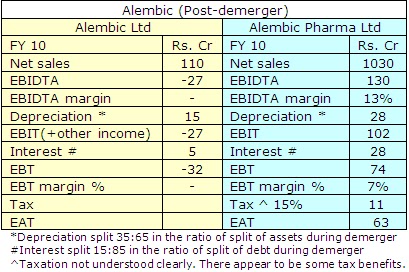
  • The pre-demerger numbers of Alembic also include those of PenG division. This is a loss making division of the company, with Rs.115 cr revenues and Rs.24 cr loss before tax for FY10.
  • If the FY10 numbers are split to reflect the demerger effect, it would be as follows: 


The opportunity:

Let us try and value the two businesses separately:

Alembic Pharma Ltd:
  • This company would contain the API and formulations business (domestic as well as export). FY10 revenue attributable for this company was Rs.1030 cr, with operating profit margins of around 12.7% and PBT margin of 6.8%. EBITDA of Rs.130 cr and EBT of Rs.74 cr.
  • The business is profitable and growing at 10-12%. APL also has recognized brands such as Althrocin, Roxid and Azithral in its portfolio.
  • Post demerger, APL would have no further need of expansion. Consequently, the free cash generated by the business would be utilized for repayment of debt. (APL debt Rs.350 cr. Alembic total cash from operations for FY10 Rs.127 cr). Consequently, in the EV, the debt should be replaced by market-cap going forward next couple of years.
  • Alembic’s peers and companies in the sector quote at premium valuations, as much as 12x EV/EBITDA and 24x TTM EPS.
  • Valuing Alembic at lower multiples of 10x EV/EBITDA(FY10) and 15x FY10 PAT, market cap comes to around Rs.950 cr. Value per share = 950/18.84 = Rs.50/- (to be used as a reference only).

Alembic Ltd:
  • Post demerger, Alembic will be left with the loss making PenG business, land and power assets. Also, it will have 29.5% stake in APL. Residual assets of Alembic would be Rs.250 crores, which is 35% of gross block.
  • On a conservative basis, I would value the PenG business at ZERO (although it certainly should be accorded some value).
  • Alembic will hold 29.5% of APL, which is worth Rs.280 cr. I am giving a 90% haircut to this and taking only 10% of the value, Rs.30 cr. (Pessimistic calculations help provide some MOS)
  • The power assets consist of 3 cogen plants, total 11 MW and 4 windmills of total 5 MW. Since they are used for captive consumption, I would accord them ZERO value.
  • Alembic would also have land of 115 acres at Vadodara. Out of this, the manufacturing facilities occupy about 45 acres. So what should be valued is only 70 acres. As per information obtained, the land rate in the area is Rs.600-700 per sq.ft. I would value the land at Rs.500/sq.ft. Valuation works out to Rs.140 cr.So, the residual business of Alembic may be valued at Rs.30 cr + Rs.140 cr = Rs.170 cr, or Rs.13 per share.

Total valuation comes to Rs.63 per share. (Rs.50 for APL and Rs.13 for Alembic)

To sum up:
  • Dilution in APL is killing off possible arbitrage in the deal.
  • To get some margin of safety, stock can be bought below Rs.55 per share.
  • There is a probability that BOTH the companies may get delisted for some period of time. (Got to get clarification from the CS on this).
  • regarding the time involved in this deal happening, the management had this to say in a recent TV interview: "The demerger is in process right now. We are awaiting some final approvals which we should hopefully get by the end of December and if all the timelines go well then hopefully by about March we will look at listing a separate company."

At CMP of 67 bucks, I do not think there is much money to be made. Lets hope that the stock drifts down. Position should be taken only if the stock comes at a price where there is comfort.

Cheers and happy investing!

Friday, November 26, 2010

Dai-ichi Karkaria - A value investor's delight?

The reason why I am calling it a 'value investor's delight' is as follows:


* The debt of Rs.1 cr is a deferred sales tax loan.
* Additionally, Dai-ichi holds 8100 shares of Bank of India (market value Rs.37 lakhs) and 57000 shares of Clariant Chemicals (market value Rs.4 cr).


At present market cap, the company is quoting just at its cash and cash equivalents. Plus, there are additional investments in shares, as detailed above. The operating business is available free! Indeed, a value investor's delight.
Sounds good? Well lets get some more dope on it...

  • The company has some real estate asset on which it receives yearly lease rent of Rs.1.5 cr. This asset (which could be a property in some posh area) would be very valuable. No details of the same are available. But this value provides some more MOS to the buyer of the business.
  • The business of the company is cash flow positive and has been generating cash from operating activity.
  • In April 2010, the company completed buyback of 1.55 lakh shares at an average price of Rs.35.74 per share. (Equity pre-buyback was 76 lakh shares)
So the next logical thing to do would be to see performance of the operating business:
  • Dai-ichi is essentially a specialty chemicals company. More details of the products can be obtained here.
  • The company has 2 subsidiaries, Basic Oil Treating India Ltd (no longer a subsidiary) and Dai-ichi Gosei Chemicals India Ltd.
  • The operating performance of the company for the past few years has not been very encouraging, as follows:

  • As can be seen, over the last 5 years, the operating business of the company has not gone anywhere in terms of topline growth. 
  • However, a slow change is seen in the efficiency of operations, with the business becoming profitable at the operating level. This is a positive sign.
  • The company has recently entered into an agreement with CTI Chemical Asia Pacific, a subsidiary of a US specialty chemicals MNC. Due to this agreement, Basic Oil Treating India Ltd, which was Dai-ichi's wholly owned subsidiary will become a 50-50 joint venture of with CTI. Details of the agreement can be found here. Essentially, this deal values Dai-ichi's stake in the JV at Rs.3.7 cr.
So should one buy shares of Dai-Ichi? I, for one, would not be buying the shares for the following reasons:

  • Though this is a great opportunity for someone who wants to buy the entire business, its not so for a small minority shareholder. I, being in the later camp wont be buying.
  • The company is not strong on the operating front. Some cases launched against it by clients like ONGC don't speak too well about the core business.
  • Financially too, the operating business is not making money. The company's profitability has sustained only due to the income it receives on its investments.
  • The cash, which is presently on the books, has come on the balance sheet just last year. Now, whether it will stay there is a big question. Typically, in small companies like these, cash moves around as per the wishes of the promoters! So, I wouldn't want to take that risk.

In short, value exists, but VALUE IS VALUABLE, ONLY IF ITS VALUE CAN BE PROPERLY VALUED!!!
In case of Dai-Ichi, the value might not be valued! I would prefer to stay away from it.

Cheers and happy investing!!

Binani Cement - Delisting

A big hello after a long time folks. And my apologies for not being able to post often. However, past performance (or lack of it) may not be sustained in future! :-) So, unlike the recent past, I aim to be more proactive now.

Coming to the point, the post is to discuss the Binani Cement delisting play and a possible opportunity to earn some dough here.

Some basics:


As can be seen, at present EV, Binani Cement is not very expensive. However, given the present scenario in the Cement sector, it is not very cheap either!

Let us now look at the shareholding pattern:


The promoters need 20.1% to delist. J P Morgan Special Situations Mauritius Ltd. and Ganesha Prime Holdings Mauritius Ltd (a subsidiary of Stansen Holdings Singapore) together hold 21.4%. So the delisting would require the co-operation of only these two parties.

So let us check out the history of what these big guys have done:

  • J P Morgan had acquired 25% stake in Binani Cement @ Rs.24 in 2005. Out of this, they disposed 10% @ Rs.75 through an offer for sale in 2006-07 IPO. They further sold 3.4% more in the 2010 buyback @ Rs.90. They hold remaining 11.6%.
  • Ganesha had also acquired its 10% stake pre-IPO. They haven't sold anything yet.

Now to the key question; what would be the delisting price?
The floor price has been set at Rs.82.  The company had recently done a buyback @ Rs.90, in which JP Morgan had participated. So logically, they would not tender shares at a price less than Rs.90. Being the majority non-promoter shareholder, they can surely influence the price. In my view, the minimum delisting price would be Rs.90.

Let us also do a risk analysis:

Valuation risk:
I have not participated in a lot of delisting cases, because valuations did not make sense. However, in the present case, the valuations are not very expensive. This risk is low in my opinion.

Event risk:
This is the risk of the event not happening at all and the delisting getting cancelled. However, the promoters have already taken all the steps to go for delisting. They have increased their stake through buyback. The shareholding is also not scattered, making delisting relatively easy. The promoter who is delisting (Binani Industries) has about Rs.500 cr cash on its balance sheet. The financing for delisting is also not a problem. The event risk is therefore low in my opinion.

Promoter risk:
This is the risk of the quality of the promoters. The Binani Group has not been minority shareholder-friendly in the past. Their actions in Binani Metals in the past speak for themselves. In my opinion, the promoter risk is high. I wouldn't trust them 100%.

Time risk:
This is the risk of the delisting getting delayed. However, I think that the time is ripe for them to delist, considering the depressed market conditions and negatives associated with the sector. The postal ballot for going ahead with the delisting has already been sent. In my opinion, it will take 40-45 days for the reverse book-building process to start. The time risk is therefore low, in my opinion.

To conclude:
With a floor price of Rs.82, Binani offers an opportunity with relatively less downside. A minimum 10% upside is visible, with a holding period of about 2 months. Delisting can be very much successful, due to the concentrated shareholding. However, given my discomfort with the promoter quality, I would not take a huge position in this situation.

Cheers and happy investing!